
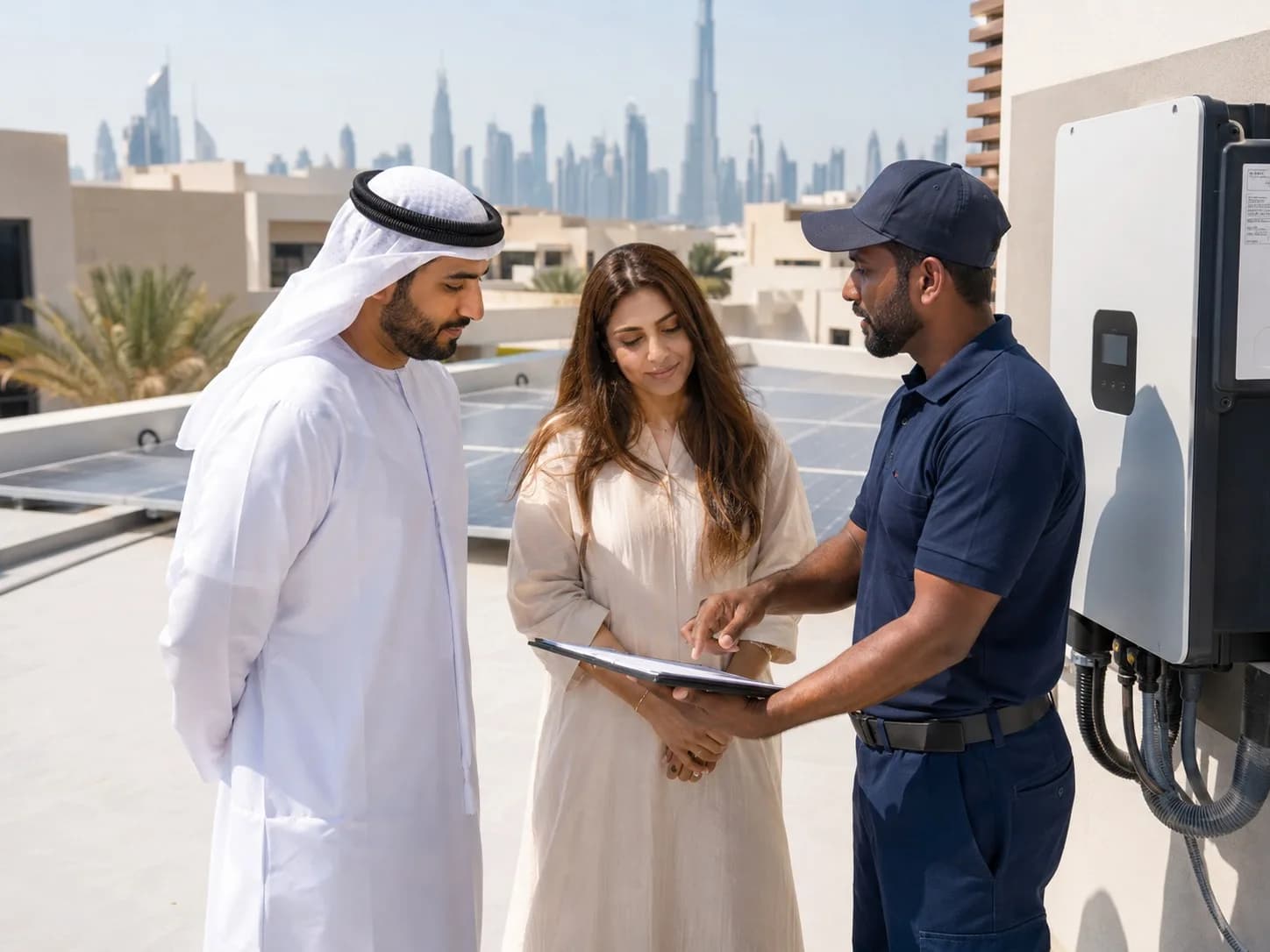
A villa advertised with solar panels is really two assets in one contract. There is the property, and there is an electrical installation on its roof that carries approvals, meters, an inverter, monitoring access, warranties, maintenance duties and a connection record tied to the premises. Buying a Dubai villa with solar panels means verifying the second asset as carefully as the first, because panels that are present are not automatically owned, operational or transferable.
What are you actually acquiring?
Start by writing down what the seller says you are getting, then test each item. Modules and mounting. An inverter, and possibly an optimiser or a battery. Isolators, cabling, labelling and earthing. A meter arrangement. A monitoring platform with a login. Warranty documents. A maintenance contract, or none. And the approval and connection file that made the installation legitimate in the first place.
Any of those can be missing, expired, owned by someone else or tied to a person rather than the property. The panels are the visible part and the least informative one.
The connection and approval file
DEWA's Shams Dubai programme is the framework under which building owners may install solar photovoltaic systems, consume the generated electricity on site and export surplus to the grid through the applicable connection process. What matters to a buyer is not the programme's existence but this property's file within it.
Request the approval and connection documents, the as-built electrical information, evidence that the equipment was eligible, the inspection or commissioning records, and the premise or account references used for the installation. Then reconcile them: the address, the meter, the installed capacity and the equipment listed should match across every document and match what is physically on the roof. Ask who designed and installed the system, whether that firm is still contactable, and whether anything has been modified since. This reflects what was published as of September 2026 and can change; confirm the current requirements and process directly with DEWA before you rely on them.
Who owns each component?
Do not assume the seller owns the system outright. Systems are financed, leased, supplied under a developer or community programme, or installed with a service agreement attached. Any of those can leave a third party holding title to the equipment, a right to payment, or a right to remove it.
Ask for written confirmation that no third party retains ownership, payment rights or removal rights over any component, and list the system in the sale inventory with serial numbers where practical. If the sale documents do not describe what is included, the argument after transfer is about the word "fixtures", and that argument is expensive.
Inspecting the array and the roof under it
Two different specialists are needed, and confusing them is the common mistake. The electrical inspection covers modules, mounting, cable routes and support, isolators, the inverter, labelling, earthing, visible damage, shading from new structures or trees, and safe access for cleaning and maintenance. The building inspection covers what the array sits on: roof penetrations, the waterproofing around them, drainage paths that panels and frames may obstruct, and whether future roof works would require the array to be removed and reinstalled.
A system can generate perfectly well while a badly detailed fixing quietly admits water into the roof build-up. Ask when the roof was last inspected, whether penetrations were sealed by the roofing contractor or by the solar installer, and whether any leak has been reported since the installation.
Reading production data without over-reading it
Ask for monthly or annual production and export data, monitoring screenshots, inverter logs and the electricity bills covering the same periods. Then read them carefully rather than enthusiastically. Occupancy, air-conditioning use, weather, panel cleaning, shading and system downtime all move the numbers, and a comparison between a half-occupied year and a full one tells you very little.
Separate four things that get blurred together: gross generation, what was consumed on site, what was exported, and how any of it appears on the account. Historical output is evidence that the system worked, not a promise about what it will do for you. Treat any projection of future savings offered by a seller or installer as an assumption to be tested, not a figure to be priced into your offer.
Warranties, monitoring access and maintenance
Build a single schedule covering the module warranty, the inverter warranty, workmanship, the mounting system, the roof waterproofing around penetrations, and any maintenance contract. For each, record the start date, the remaining term, the exclusions, whether notice is required to transfer it, which service providers are approved under it, and whether proof of purchase exists.
Then deal with access, which buyers forget until it is too late. Monitoring credentials, administrator rights on the platform, any SIM card or internet dependency, and alarm notifications all need to be transferred to you in writing. A system that only the seller or an uncontactable installer can log into is a system you cannot manage, diagnose or claim under.
Closing the system handover with the property
Agree a system handover that runs alongside the property handover: the inventory, the document pack, the passwords and platform transfer, meter and account actions, any outstanding service visit, and who is responsible if a component fails between agreement and transfer. Take a dated photograph of the inverter display and the meter reading on the day, exactly as you would take utility readings.
Confirm the current DEWA process for updating premise ownership or account details, and ask whether anything under the solar connection needs to be updated too. The DEWA connection deposit is commonly cited as AED 2,000 for an apartment and AED 4,000 for a villa; confirm the current amount and the process with DEWA rather than relying on a figure or on the seller's recollection of how their own account was handled years ago.
When does this apply?
It applies to any resale villa with an existing array, to a villa where a previous owner installed a system that has since been disconnected, and to a new handover where solar was part of the specification. In the last case, the developer's documents, the commissioning records and the defects liability period, typically twelve months from handover and developer-specific, are your starting point.
It applies in a modified form to an apartment or townhouse in a managed community, where the roof may be common property and the owners' association, not you, controls what happens on it. There, ask who owns the roof, who owns the system, how any benefit is allocated to units, and what the community rules say before you treat rooftop generation as part of the purchase.
Bottom line
Value the villa as a villa, then treat the solar installation as a separate asset with its own file. Verify approvals and connection records, confirm clean ownership of every component, inspect the electrics and the roof separately, read production data as history rather than forecast, and take custody of warranties and monitoring access in writing before transfer. A well-documented system is a genuine benefit; an undocumented one is somebody else's project that you have agreed to inherit.
Frequently asked questions
Does a solar system transfer automatically with the villa?
Do not assume it does. Confirm in writing that the seller owns every component outright, that nothing is leased, financed or supplied under a separate agreement, and that no third party has removal or payment rights. List the system in the sale inventory, transfer the warranties and monitoring credentials, and confirm the current DEWA account and premise process before completion rather than after it.
Can past production data tell me what I will save?
No. It tells you the system generated electricity under a particular household's occupancy, usage pattern, weather, cleaning schedule and system condition. Your consumption profile will differ, and so will the result. Use the data to confirm the system has been working and to spot downtime or a declining trend, not to build a savings figure into the price you offer.
Who should inspect the system before I buy?
Use a competent electrical or solar photovoltaic specialist for the installation itself, and a separate roofing or waterproofing specialist for the penetrations and the roof build-up underneath. Confirm what DEWA currently requires in terms of enrolment or eligibility for anyone carrying out regulated work. One inspector covering both disciplines is possible, but ask directly which qualifications they hold for each.
What if the installer has gone out of business?
It is common and not fatal, but it changes what you are buying. Workmanship warranties usually die with the installer, while manufacturer warranties on modules and inverters may survive if you hold proof of purchase and the serial numbers. Establish which category each warranty falls into, obtain the documentation, and get a current inspection so you know the system's condition independently of anyone's promises.
Should the panels reduce the price if they are not working?
A non-functioning system is a defect like any other, and it should be treated as one: diagnosed, scoped, priced by a qualified contractor, and either repaired before transfer or reflected in the terms. What you should not do is accept a vague discount for a fault nobody has investigated, because a dead inverter, a shading problem and a roof-level wiring fault carry very different costs.
Can I add or expand a system after I buy?
Possibly, but it is a regulated installation, not a home improvement. Check the current DEWA requirements and approval process, the roof's capacity and condition, the available electrical capacity at the premises, and any community or owners' association rules on external alterations. If you are buying partly in order to expand, confirm the route before committing rather than assuming the existing approval extends to more capacity.
Related guides
- Green Building Ratings in the UAE: What Property Buyers Should Verify
- EV Charging Readiness in Dubai Apartment Buildings: Buyer Checklist
- Smart Home Apartment in Dubai: Buyer Checklist Before You Pay a Premium
- DEWA Move-In, Move-To and Move-Out in Dubai: How Each Works (2026 Property Guide)
- Renovating an Apartment or Villa in Dubai: Permits, NOCs and Contractor Checks
Laguna Life is a DLD/RERA-registered brokerage that starts from your goal rather than from what is for sale, and verifies every figure at its official source. Tell us which solar-equipped villa you are considering and we will help you build the document, inspection and handover list before you sign. WhatsApp wa.me/971561000928 or visit lagunalife.ae. Register your interest now.