
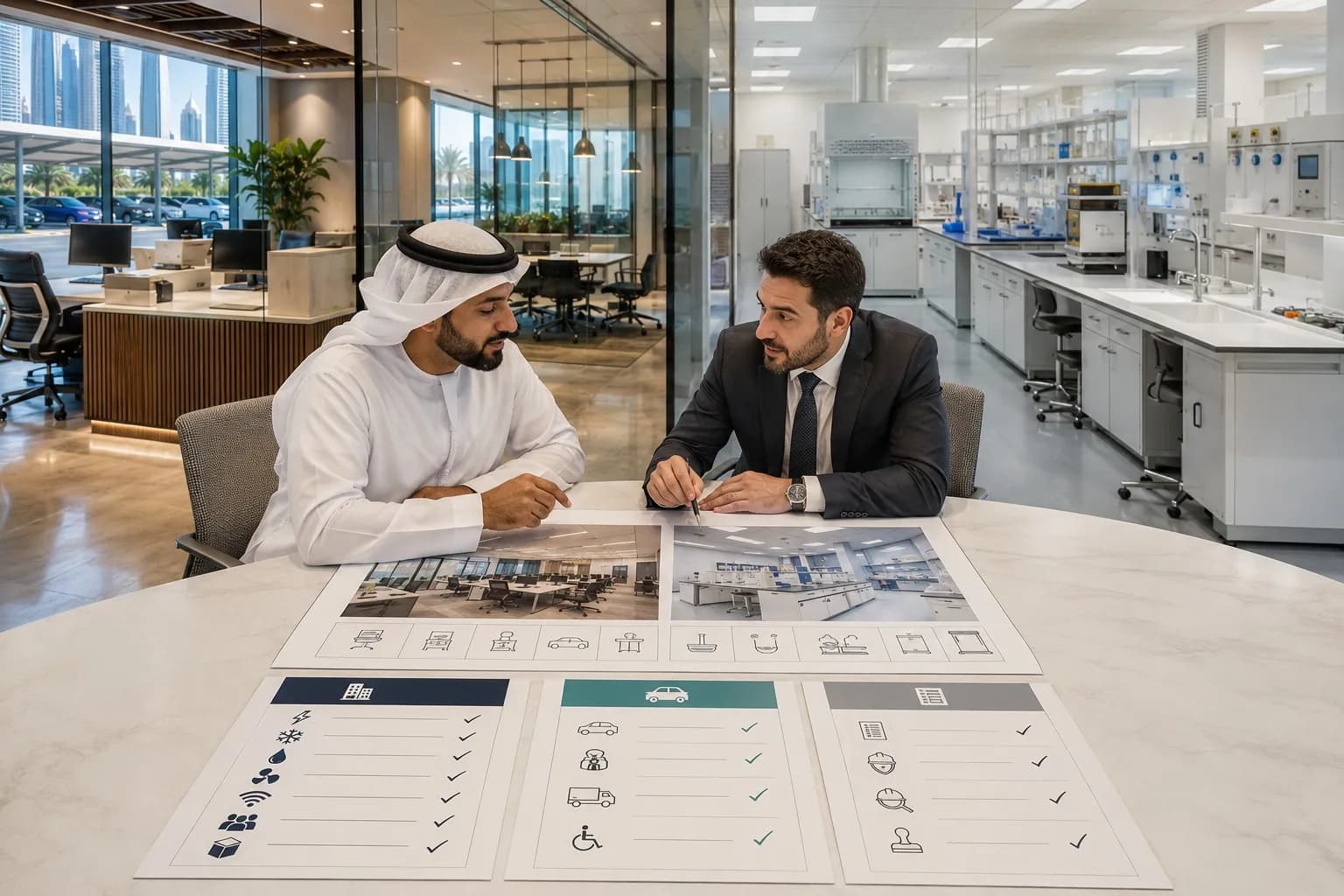
Dubai Science Park is a TECOM Group business district in Al Barsha South, built around science, healthcare and technology occupiers, with residential buildings standing alongside the commercial stock. That mix is the reason the name confuses buyers: an office, a fitted laboratory and an apartment in the same district are three different assets with three different rules. This guide separates them.
Where does the district sit, and what is it for?
Dubai Science Park occupies part of Al Barsha South, in the developing belt that also holds Arjan and the newer communities on that side of the city, reached by road rather than by Metro. There is no station inside the district, so commuting here is a car or bus journey and should be timed at the hour you would actually make it.
Its purpose is what distinguishes it. TECOM describes an ecosystem of more than 500 customers and 6,500 professionals across science, healthcare and technology activity. That concentration creates a specific demand base, for space and for homes near it, which is useful only if the unit you are considering can lawfully serve it.
What kinds of space does the district contain?
Dubai Science Park holds three broad categories of space. Conventional offices, suitable for administrative and commercial occupiers. Science-oriented facilities, including laboratory and light technical space with utility, ventilation, drainage and safety requirements a normal office does not meet. And residential buildings, which serve people working in and around the district.
Before comparing anything, confirm whether the asset actually sits inside the relevant district or free-zone boundary and whether its title and permitted use match the way it is being marketed. A building described as being in Dubai Science Park is only in it if the title and the boundary say so.
Which residential buildings do people search for?
Orchid Residence
One of the named residential addresses in Dubai Science Park, and the one most searched by name. Judge it as a building rather than a brand: the unit mix, lift-to-unit ratio, covered parking allocation, whether cooling is district-supplied and billed separately from the service charge, the state of the common areas, and the approved service charge for that project and year on the DLD index. Then ask what is under construction on the plots around it.
Bella Rose
Another named residential building drawing its own search interest. The same discipline applies, with one addition specific to this district: ask who your neighbouring occupiers are. Living beside laboratory, clinical or light technical uses is fine for many households and wrong for others, and it affects delivery traffic, out-of-hours activity and parking in ways a viewing at noon will not reveal.
What changes when the asset is a laboratory?
Almost everything. A compliant laboratory needs power capacity, ventilation and extraction, drainage suited to its effluent, controlled storage, waste handling and authority approvals that a standard office simply does not have. Retrofitting those into ordinary space is expensive and sometimes not permitted at all.
That specification also narrows the tenant pool. Space that only one kind of occupier can use is harder to relet and harder to sell, and the cost of converting it back to conventional use belongs in your model from the outset, not as an afterthought when the tenant leaves.
How do licensing and permitted use affect value?
Start from the intended tenant's activity and the authority that licenses it, then verify the permitted activities for the unit, the occupancy and access arrangements, the rules on hazardous materials and the fit-out approval route. Only then estimate rent, because a rent that assumes an activity the unit cannot lawfully host is not a rent at all.
The same logic applies to comparable evidence. A conventional fitted office is not a valid rent comparable for a compliant laboratory. Compare the same use class, fit-out condition, floor efficiency and lease structure, ask for executed lease evidence where it exists, and record the date and any concessions such as rent-free periods or fit-out contributions.
What should you verify before buying or leasing?
Everything starts with the register. Dubai REST will return the title record against a certificate number, year and property type; what you are testing is that the vendor is the registered owner, that no mortgage sits behind the deal, and that the recorded use matches the use you intend. Then the recurring cost: the approved per-square-foot rate for the project and year is published on the DLD index, and whether cooling is invoiced separately is a question to ask outright rather than infer. On a resale, the developer's no-objection certificate is what lets the transfer register at all.
An off-plan purchase adds its own layer: a RERA project number with a published completion percentage, instalments that go nowhere except the escrow account required by Dubai Law No. 8 of 2007, and Oqood entry, which is where the 4% DLD fee falls. A residential letting is registered through Ejari, and a renewal increase is bounded by the RERA Smart Rental Index slabs after ninety days' written notice. All of this is Dubai law and Dubai practice as published in September 2026; it moves, so confirm it before you act on it.
What protects the exit?
Clear title and permitted use, a flexible layout, documented approvals, systems that can be maintained by more than one contractor, and adequate parking and loading. Those are the attributes that keep a future buyer or tenant interested when the current one leaves.
For specialist space, model the reinstatement cost explicitly. For residential, the exit rests on the ordinary things: a mainstream unit type, a transparent service charge, a building that has been maintained, and a district that is still filling out rather than one whose surrounding plots are unknown.
Who does the district suit?
Dubai Science Park suits occupiers whose activity genuinely belongs here and who need proximity to the cluster, and investors prepared to underwrite specialist commercial space with a narrow tenant pool and treat it as such. On the residential side, it suits people working in or near the district who want a newer apartment and accept a car-based routine.
It suits you less if you want generic office exposure, which is cheaper to underwrite elsewhere, or a residential purchase with the deepest possible resale market, or Metro access. It is also the wrong district for a buyer who intends to convert conventional space to laboratory use without first proving that the conversion is permitted and affordable.
When does this apply?
This guide applies when a district's name covers commercial, specialist and residential assets at once, and when the marketing does not distinguish between them. It applies to purchase and to leasing, and to both sides of the district's stock. It is not a valuation, a survey, or legal or licensing advice, and it quotes no prices or rents.
Everything procedural here is Dubai's and reflects what was published as of September 2026; rules and fees change, so confirm through the DLD, RERA, Dubai REST and the relevant licensing authority before relying on any of it.
Bottom line
In Dubai Science Park the asset class matters more than the address. Establish first whether you are buying an office, a specialist facility or a home, then prove the boundary, the title and the permitted use, then worry about the building. A unit that cannot lawfully do what your tenant needs has no rent, whatever the district's reputation.
Laguna Life is registered with the DLD and RERA. We work backwards from what you need the property to do, not forwards from what is on our books, and we source every number officially.
Frequently asked questions
Where exactly is the district?
It sits within Al Barsha South, on the developing side of the city near Arjan and the newer communities there, and is reached by road. There is no Metro station inside it, so plan on driving or using buses and measure the journey at your real commute hour. Confirm the precise boundary for any specific building, because plots adjacent to a district are often marketed as though they were inside it.
Is every unit suitable for a laboratory?
No. Laboratory use depends on permitted activity, power capacity, ventilation and extraction, drainage, controlled storage, waste handling and safety approvals from the relevant authority. A conventional office rarely has these, and retrofitting them can be costly or simply not permitted. Verify the position for the exact unit, in writing, before you price any lease or purchase around a laboratory tenant.
Can nearby residential property be described as being in the district?
Only if the official title and the district boundary support that description. Marketing language is not evidence. Check the title deed and the boundary before you accept the description, because the difference affects which comparable transactions apply, which occupiers are genuinely nearby, and how a future buyer will search for and value the unit.
Why can fit-out cost so much more here?
Because specialist occupiers need power, ventilation, drainage, containment, safety systems and compliance documentation far beyond a standard office fit-out, plus professional design and authority approvals. Reinstatement at the end of a lease can be similarly expensive. Model both the initial fit-out and the reinstatement, and confirm who bears each under the lease before you agree a rent.
What is the main resale risk?
A narrow pool of buyers and tenants for highly specialised space. The more a unit is tailored to one activity, the fewer parties can use it, and the longer it may sit vacant between occupiers. Prefer flexible layouts, documented approvals and maintainable systems, and price the conversion cost back to conventional use into your assumptions from the beginning.
What should a residential buyer check here specifically?
The ordinary building checks, plus the neighbours. Confirm the approved service charge on the DLD index and whether chiller charges are separate, check the lift-to-unit ratio and covered parking, and inspect the common areas. Then ask what occupies and what is planned for the adjacent plots, and visit at an evening and a weekend, because commercial and light technical neighbours behave differently outside office hours.
Related guides
- Dubai Internet City Property Guide 2026: Offices, Ownership and Tenant Demand
- Al Barsha Property Guide: Apartments, Villas and the Southern Districts
- Arjan Dubai Property Guide: Apartments, Connectivity and Investment Checks
- Rent-Free Periods and Fit-Out Contributions in Dubai Commercial Property
- Barsha Heights Dubai Property Guide: Apartments, Offices and Metro Access
Tell us whether you need space for an activity or a home near one, and we will check the boundary, the title and the permitted use before anyone talks about rent. WhatsApp +971 56 100 0928 or visit lagunalife.ae. Register your interest now.