
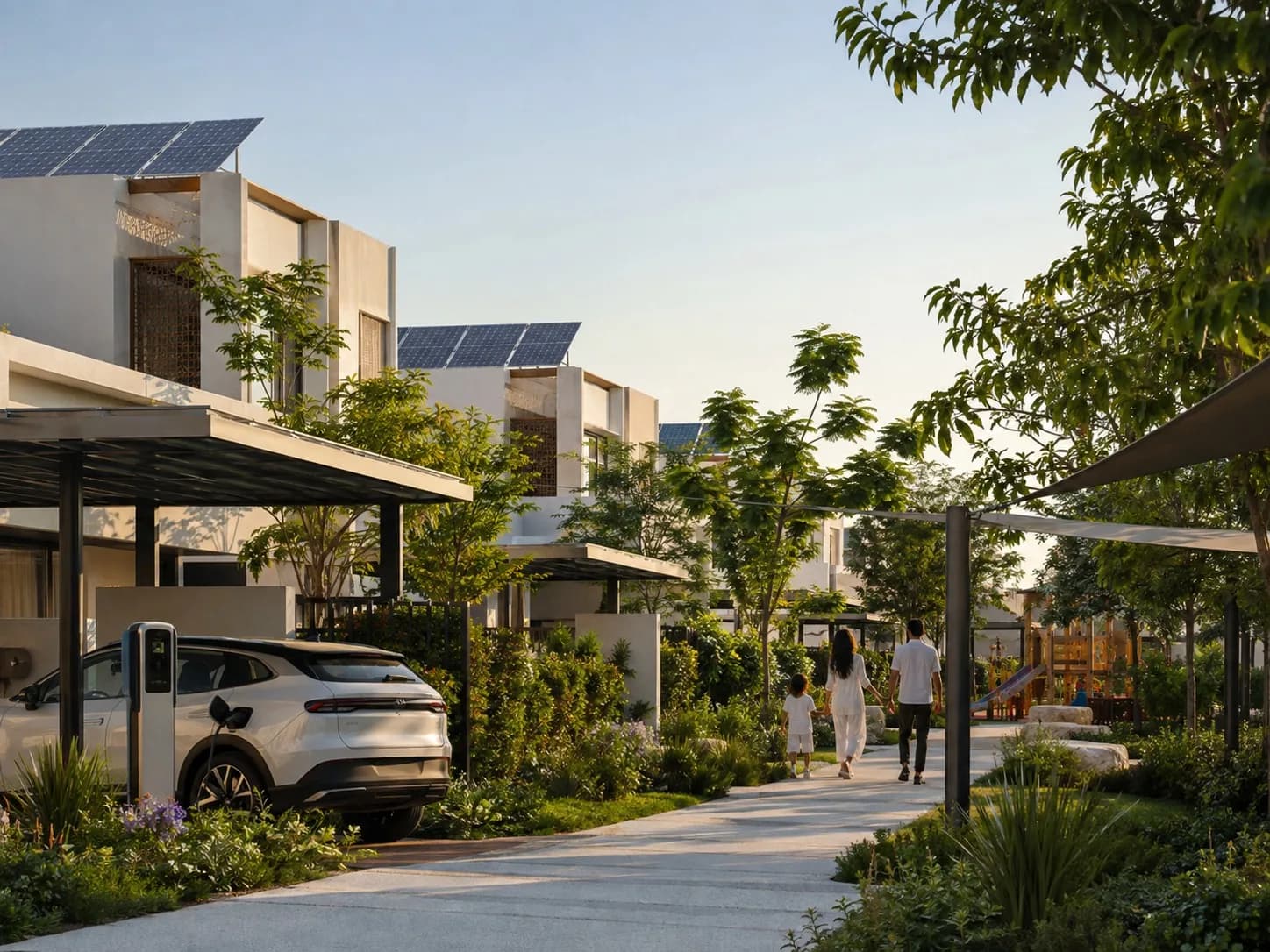
Sharjah Sustainable City is a master-planned villa community in the emirate of Sharjah, built around solar generation, treated-water irrigation, recycling and clean mobility. This guide is for the buyer or tenant who needs to know which of those systems serve the villa in front of them, who maintains them, what they cost over time, and which rules apply in Sharjah rather than Dubai.
Which rules apply here, and which Dubai rules do not?
Sharjah runs its own land registration, ownership and tenancy system. The Dubai Land Department procedures we cover elsewhere — the 4% DLD transfer fee, Oqood interim registration, the RERA rent-index slabs, Ejari, Mollak service-charge publication — are Dubai instruments. Do not assume any of them apply to a purchase or lease in Sharjah Sustainable City, and do not let an agent quote a Dubai figure for a Sharjah deal.
Confirm with the Sharjah Real Estate Registration Department, and with the developer in writing, who may own here, what form the ownership takes, what fees apply and how a tenancy is registered. These points reflect what was published as of September 2026 and can change; verify at the official source before you commit.
Where does the community sit, and how do you actually get there?
It sits inland in Sharjah, away from the older coastal districts, in a corridor suiting residents who work in Sharjah and those driving daily into Dubai. That second group needs the most care: the Sharjah–Dubai commute is one of the heaviest in the country, and a map radius tells you nothing useful about it.
Drive the route yourself at the hour you would really leave, and again on the return leg, on a working weekday. Check where school buses collect, how the gates handle morning queuing, and the journey to the hospital, supermarket and office you would actually use.
What does the Sharjah Sustainable City housing stock look like?
The stock is villas rather than apartments, in a small number of bedroom configurations, delivered in phases. Two villas with the same bedroom count can still differ in plot size, orientation, garden depth, distance to community facilities and which phase's infrastructure they sit on.
Compare built-up area against plot area, not bedroom count. Check orientation too: a west-facing living room and an unshaded garden are running costs here, not design preferences. Ask which phase the villa is in, when it was handed over, and whether specification changed between phases.
How do you verify the solar system and the savings claim?
Panels on a roof tell you almost nothing alone. Establish whether the array is dedicated to that villa, owned by the community, or part of a shared arrangement — that answer decides who benefits from the generation and who pays when a component fails.
Then ask for documents: capacity, inverter make and age, production records if any exist, warranty terms and what remains of them, maintenance history, and who is contractually responsible for replacement. For a resale, ask how the system and its warranties transfer to you. An array with no transferable warranty and an ageing inverter is a future cost, not a feature.
Treat any published saving as a target or a reported outcome for some households, not a guarantee for yours: household size, thermostat habits, daytime occupancy, EV charging and irrigation move consumption more than the specification does. For a resale, ask for anonymised utility history over a comparable period spanning a summer; for a new unit, ask for the billing structure and the assumptions behind any illustration.
What do the water, waste and landscaping systems commit you to?
The stated model treats wastewater for landscape irrigation and designs recycling to divert waste from landfill. These are community-scale systems, so the useful question is where the boundary falls between the community's responsibility and yours.
Walk the plot: check irrigation coverage and pressure, drainage away from the building, odour near treatment or collection points, pest evidence and the condition of planting. Ask in writing which landscaping the community maintains, what residents must separate, how it is funded, and what happens to your garden if the shared supply is interrupted.
EV readiness and smart-home systems: what are you really buying?
"EV-ready" is not the same as "has a charger". It can mean a live charger at your space, an electrical provision waiting for one, or access to shared chargers elsewhere. Confirm which applies to your allocated parking, then ask about capacity, billing, booking of shared units, who maintains them and what approval an upgrade requires.
For smart-home systems, ask for a live demonstration, not a spec sheet. Check which app controls it, whether it is still supported, who holds administrator access, what the warranty covers, and the plan when a device reaches end of support.
Why is long-term maintenance part of sustainability?
A low-consumption home still has hardware, and hardware has a replacement cycle. Build your ownership-cost model around the equipment: panels, inverters, batteries where present, smart controls, pumps, irrigation and EV kit, plus the ordinary villa items of cooling, roofing and waterproofing.
Ask what the community charges cover, whether a reserve fund exists for major replacements, how it is funded and who approves spending from it. Sharjah Sustainable City does not sit on Dubai's Mollak platform, so request the community's own budget and audit documents directly.
What should you verify before buying or renting here?
- Ownership eligibility and the form of title or lease, confirmed with the Sharjah authority, not assumed from Dubai practice.
- Sharjah registration, transfer and tenancy-registration fees, documented.
- The phase, its handover date and any specification change between phases.
- Solar ownership model, capacity, inverter age, warranty transfer and maintenance record.
- Utility history across a full summer, or the assumptions behind any savings illustration.
- EV charging status at your parking space, with billing and booking rules.
- An independent inspection: roof, waterproofing, drainage, cooling, irrigation, pest history.
Who does Sharjah Sustainable City suit, and who does it not?
It suits a household that genuinely wants low-consumption living and will engage with it — separating waste, running the systems properly, maintaining the equipment — and values space and quiet over a central address. It also suits a family whose work and schooling are in Sharjah, or whose Dubai commute is off-peak or partly remote.
It suits you less if you need a daily peak-hour Dubai commute and will resent it; if you want an apartment or a dense, walkable setting; if you expect the sustainability equipment to be someone else's problem; or if you assume Dubai's ownership, financing and rental rules carry over, because they do not.
When does this apply?
This is a framework for evaluating a home, not advice on a specific villa or phase. Everything jurisdictional here is Sharjah's, and Sharjah differs from Dubai on ownership eligibility, registration, fees and tenancy. Our guides citing the Dubai Land Department, RERA, Ejari, Mollak or the 4% transfer fee describe Dubai and should not be applied here without checking the Sharjah equivalent.
Mortgage lending is governed by Central Bank of the UAE regulation, so loan-to-value ceilings, the 50% debt-burden limit and the 25-year maximum tenor are federal; conditions a lender applies to a given emirate or community are its own. These points reflect what was published as of September 2026 and can change; verify at the official source.
Bottom line
Sharjah Sustainable City is a genuine low-consumption proposition, and the sound way to buy into it is to treat every published feature as a question rather than a promise. Establish who owns each system, who maintains it and how it transfers, then confirm the Sharjah ownership and tenancy position separately, because none of Dubai's process carries over automatically.
Frequently asked questions
Is Sharjah Sustainable City in Dubai?
No. It is in the emirate of Sharjah, which has its own land registration authority, ownership eligibility rules, transaction fees and tenancy system. The Dubai Land Department fee schedule, Oqood, Ejari, the RERA rent index and Mollak are Dubai instruments and do not apply here automatically. Ask the developer and the Sharjah authority for the Sharjah position in writing before you budget.
Does sustainable design guarantee a fixed saving on utility bills?
No. Published savings are targets or reported outcomes for particular households, not a guarantee for yours. Occupancy, household size, thermostat settings, daytime presence, EV charging and irrigation all move consumption substantially. Ask for anonymised utility history over a comparable period including a summer, and for the assumptions behind any illustration shown to you.
Should I inspect the solar system on a resale villa?
Yes, in detail. Establish whether the array serves the villa, the community or a shared arrangement. Then request capacity, inverter make and age, production records, warranty terms and remaining cover, maintenance history and who is responsible for replacement. Confirm how the system and its warranties transfer to you on sale — an ageing inverter with no transferable warranty is a cost you inherit.
Is "EV-ready" the same as having a charger?
No. It can mean a working charger at your space, an electrical provision with no unit installed, or access to shared chargers elsewhere in the community. Confirm which applies to your allocated parking, then ask about available capacity, billing, whether shared units require booking, who maintains them, and what approvals you need to install or upgrade a unit.
Can a foreign buyer own a home here?
Eligibility in Sharjah is set by Sharjah's own rules, and the ownership form available to a given nationality is not the same question as in Dubai's designated freehold areas. Ask the Sharjah Real Estate Registration Department and the developer, in writing, who may own, what form the title or long lease takes, what term applies and what registration fees are due.
How does a mortgage work for a property in Sharjah?
Central Bank of the UAE mortgage regulation is federal, so loan-to-value ceilings, the 50% debt-burden ratio and the maximum tenor apply nationwide. What varies is an individual bank's appetite for the emirate, community and property type. Get a pre-approval before you shortlist, and confirm with the lender that it finances here.
Related guides
- Buying Property in Sharjah: A Guide for Investors and Foreign Buyers
- Is Aljada Sharjah a Good Property Investment in 2026? Buyer Guide
- Hayyan Sharjah Property Guide: Compare Neighbourhoods, Phases and Villa Positions
- Tilal City Sharjah Property Guide: Land, Villas and Community Checks
- Buying a Dubai Villa with Solar Panels: Shams Dubai and Handover Checklist
Laguna Life is a DLD/RERA-registered brokerage. We start from your goal, not from what is on the list, and verify every figure at its official source — including confirming the Sharjah position instead of assuming Dubai's. Tell us your budget, commute and household, and we will put the right questions to the developer. WhatsApp +971 56 100 0928 or visit lagunalife.ae. Register your interest now.