
Before you sign: the short answer
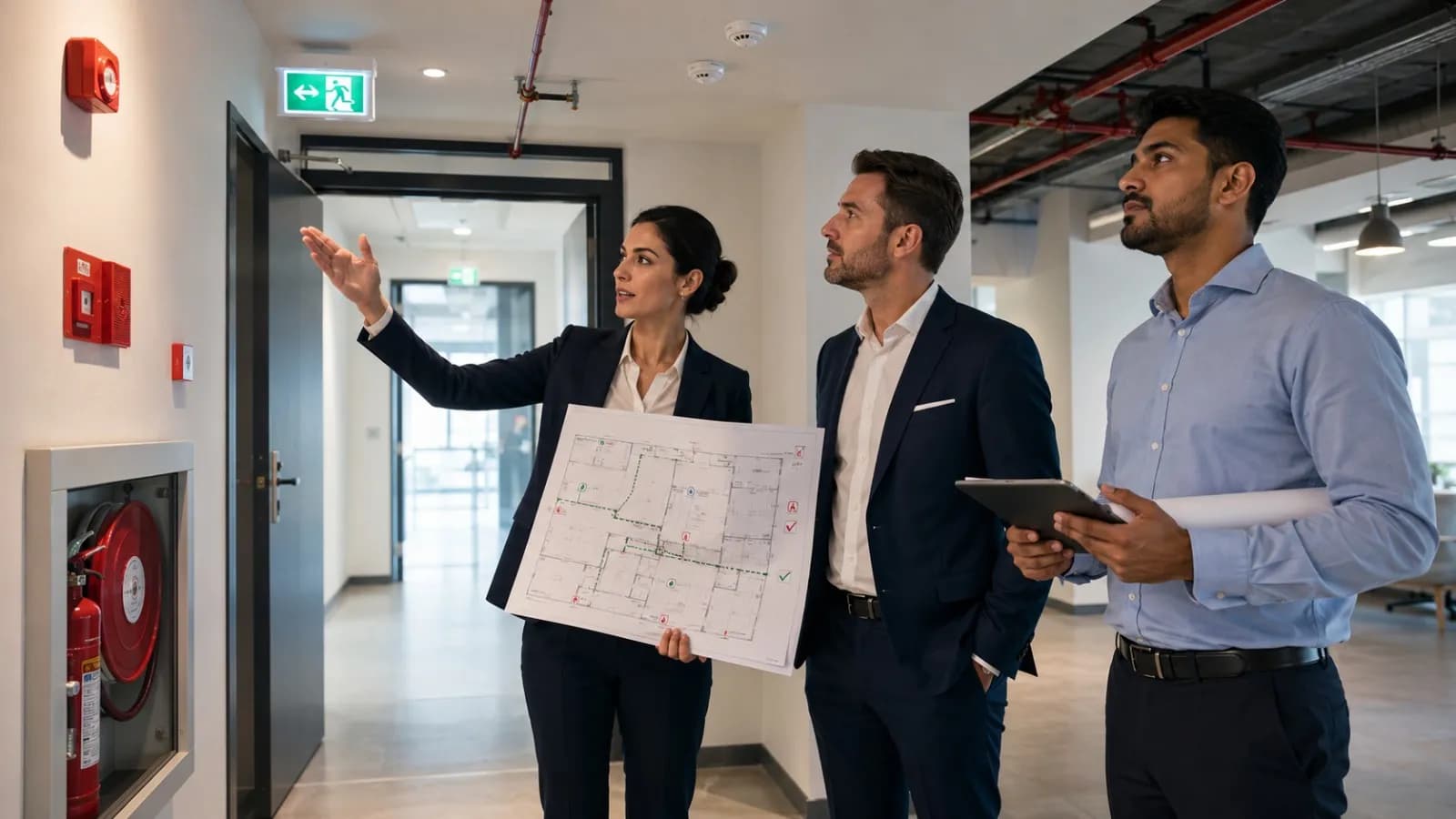
A commercial unit in Dubai only works for you if three things are true at the same time. Your activity must be allowed at that address. The premises must be able to support it physically: power, fire safety, access and layout. And the contract has to say who pays, and what happens, if an approval you still need is refused or delayed.
Most problems we see come from treating these as one question. A unit can be correctly licensed for "retail" and still be unable to take a kitchen extract. A landlord can be happy to let to you and still not hold the documents the authorities will ask for. The checks below are ordered so you find the expensive problems before you pay a deposit, not after.
Buying or renting a commercial unit: what changes in the checks
If you are buying, start with the title. The Dubai Land Department's Verify Title Deed service confirms whether a DLD title deed or certificate of title is valid, it is open to anyone, and the answer is immediate. A valid deed is the starting point, not the end: you still need to confirm the permitted use of the unit, the service charges, any master-community or building rules, and whether an existing tenant stays on. Under Dubai's tenancy law, a tenant with a fixed-term lease keeps that lease when the property is sold, so an "investment with tenant" comes with that tenant's contract terms.
If you are renting, the lease is governed by Law No. 26 of 2007 on landlord–tenant relations, as amended. Your contract is registered through Ejari. On 2 November 2026 the Dubai Land Department announced an enhanced Ejari service in the DubaiNow app: you can create and register the contract in one step, receive the Ejari certificate once it is approved, renew or cancel digitally with UAE PASS, and pay the DEWA deposit in the same journey.
Whether you buy or rent, the unit is only half the decision. The other half is whether your licence, your fit-out and your landlord's documents line up. That is what the seven checks are for.
The seven checks every commercial unit needs
1. Title, owner and permitted use
Confirm who owns the unit and that the person signing has the right to sign. For a purchase, verify the title deed with the DLD. For a lease, ask for the title deed or the owner's authority to lease, and match the names on the contract to it. Then confirm the permitted use of the unit: retail, office, warehouse or another category. Your trade licence activity has to fit it. If the listing says "suitable for any use", ask for the document that says so.
2. Approved drawings against what is actually built
Ask for the approved layout drawings and walk the unit with them. Mezzanines, partitions, closed-off shafts or added toilets that are not on the approved drawings will surface when your fit-out drawings are submitted, and fixing them usually becomes your problem. This is a practical check rather than a legal requirement, but it saves weeks.
3. Landlord, developer and community consent
In Dubai a tenant may not alter the premises without the landlord's permission and any licences the work requires. Where your works need an approval, the landlord has to give you the documents the authorities need. In practice, ask before signing for a written list of what the landlord or the building's management will provide (title, approved drawings, NOCs) and how long each takes. In master-planned communities and some free zones the developer or community operator also has to approve works, so ask who that is.
4. The fire and life-safety file
Dubai Civil Defence is now the Dubai Civil Defence General Command under Law No. 4 of 2025. Two articles matter to a tenant or buyer. Licensing authorities may not issue or renew a licence, permit or approval unless the premises hold a valid preventive-safety certificate from the Command. Owners must keep fire systems maintained and get the Command's approval before any modification that affects preventive safety. The same law also prevents insurers from covering fire risk without that certificate.
What this means before you sign: ask for the building's current Civil Defence certificate and confirm your planned layout and activity will not need changes to sprinklers, alarms or escape routes that the owner has not agreed to.
5. Utilities you can measure, not assume
Ask for the electrical load available to the unit in writing and compare it with what your equipment needs. For fit-outs, DEWA's fit-out electricity connection service is used by enrolled contractors and consultants. It needs a landlord NOC in DEWA's format. The eService itself is free of charge. Design approval takes 1 working day, the low-voltage inspection 1 working day from submission, and the invoice 3 working days. "Free" refers to the eService, not to any connection or upgrade cost. If your activity needs more power than the unit has, find out before signing who pays for the upgrade and how long it takes.
6. The licence activity has to match the unit
On the mainland, your trade licence comes from the Department of Economy and Tourism (DET). If your company is licensed in a free zone and you want to operate from a mainland unit, Executive Council Resolution No. 11 of 2025 allows it through DET in two ways. One is a branch licence: one year, AED 10,000 a year, and the branch must be physically located in Dubai. The other is a temporary permit for up to six months at AED 5,000. Both need the approval of your free-zone licensing authority. DET announced the Free Zone Mainland Operating Permit on 8 October 2025.
Whichever route you use, the activity on your licence must be one the unit is allowed to host. Check this before you sign, not after.
7. Contract and exit terms
Most of the money in a commercial lease is decided at the exit. Under Law 26 of 2007, the tenant returns the unit in the condition it was received, except for normal wear. Improvements the tenant made may not be removed unless the contract allows it. The maintenance deposit is returned less any lawful deductions. Maintenance is the landlord's responsibility unless the contract says otherwise.
Put the answers in writing: what you will be asked to remove at the end, what you may leave, what condition "as received" means (photos at handover), and what the deposit can be used for.
Fit-out approvals: who approves your works depends on where the unit is
There is no single fit-out permit for all of Dubai. The authority depends on where the unit sits.
- Dubai Municipality areas. Under Administrative Resolution No. 85 of 2019, decoration works in a unit larger than 100 m² need a Municipality permit and a completion certificate. Units of 100 m² or less, and units inside a trade centre or mall, are exempt from both. The exemption is not a free pass. The works must still use a Municipality-approved contractor and follow planning, construction and Civil Defence requirements. They also need the owner's written consent and must not change the built-up area. The Municipality may inspect.
- Dubai Development Authority areas. Where DDA is the building authority, the contractor applies for a fit-out permit with the Ejari, the owner's NOC, the required authority NOCs, an appointment letter, and stamped approved and proposed drawings. The permit is valid for six months and takes about two working days. The fee is AED 0.90 per square foot (minimum AED 200, maximum AED 10,000), plus AED 10 and AED 10.
- Free zones and other authorities. Jebel Ali Free Zone (through Trakhees) and other free zones run their own permit processes. Ask the landlord which authority approves works in that building before you price the fit-out.
Offices, coworking and business centres
If you are taking a desk or a small office inside a business centre, it helps to know what the operator had to set up. The DLD's published requirements for registering a business centre in Ejari include:
- the landlord's NOC to sublet, and a five-year head lease registered in Ejari;
- DET initial approval and a trade name, plus Municipality approval of the drawings;
- a minimum of 5,000 sq ft for the centre and at least 100 sq ft for each unit;
- no more than one contract per unit in any 365 days;
- a survey fee of AED 2,010.
As a member, ask whether the centre is registered this way and whether your unit will have its own Ejari. Your licence may depend on it. Separately, under the tenancy law a tenant may not sublet or assign without the landlord's written consent unless the lease allows it. Check this if you plan to share your own office.
Reinstatement and fit-out ownership at the end of a lease
Agree three things at signing. List which items are yours and which become the landlord's (the law says improvements may not be removed unless agreed). Record the condition at handover with dated photos and a short schedule. Price the exit: if you will have to strip the unit back to shell and core, get a contractor's estimate before you sign, not when you leave.
Find the guide for your type of business
The seven checks apply to every unit. Each business type then adds its own. Use the guide that matches what you plan to do:
Food production and food retail. Kitchens, bakeries, cafés, central kitchens and food shops add food-safety approval, grease and drainage, extract routes and gas. See Food production and food retail premises.
Retail shops and showrooms. Shopfront and signage rules, mall fit-out manuals, frontage, loading and opening hours. See Retail shops and showrooms.
Workshops and light industrial. Activity classification, ventilation, noise, hazardous materials and floor loads. See Workshops and light industrial premises.
Clinics, pharmacies and medical premises. Health-authority facility licensing, layout rules for pharmacies and treatment rooms, medical waste. See Clinics and medical premises.
Schools, nurseries and training centres. Education-authority approval, outdoor space, access and child safety. See Schools, nurseries and training centres.
Beauty, wellness and fitness. Salons, spas, barbers and gyms: public-health rules, water and drainage, ventilation and noise. See Beauty, wellness and fitness premises.
Pets, veterinary and aquatic businesses. Veterinary clinics, grooming, boarding and aquarium shops: animal separation, ventilation, drainage and waste. See Pets, veterinary and aquatic premises.
Entertainment venues, studios and galleries. Indoor play, event spaces, galleries and recording studios: occupancy, acoustics and crowd safety. See Entertainment venues, studios and galleries.
Warehouses, storage and logistics. Warehouses, cold stores and logistics units: clear height, floor loading, racking, docks and fire strategy. See Warehouses, storage and logistics.
Two specialist uses have their own guides: padel and sports facilities and auction houses and collectibles showrooms.
Specialist assets: speak to us first
Some property types depend on rights, approvals or technical systems that need a specialist review before any commitment:
- older buildings where renovation may disturb hazardous materials;
- billboard and outdoor-advertising rights;
- data centres and server rooms;
- fuel stations and car washes;
- marina and yacht berths;
- mechanical parking and car stackers;
- electrical panels and earthing in older properties;
- rooftop telecom antenna leases.
For any of these, send us the property and what you plan to do, and we will tell you what needs checking and by whom before you pay anything.
More guides on specific risks
- Accessible and universal design
- Labour accommodation
- Cloud kitchens
- Early-childhood nurseries
- Fire and life safety in commercial property
- EV chargers and parking
- Green building and Al Sa'fat
- Coastal and waterfront property
From shortlist to opening: eight steps
- Define the activity first. Write down exactly what you will do in the unit: activities, equipment, staff, visitors, opening hours. Every later check depends on it.
- Confirm the licensing route. Mainland (DET), free zone, or a free-zone company operating on the mainland. Confirm the activity is available in the area.
- Shortlist units that can physically work. Power, access, ceiling height, extract or drainage routes, loading. Ask for figures, not descriptions.
- Request the owner's documents. Title or authority to lease, approved drawings, current Civil Defence certificate, service charges, building or community rules.
- Get a fit-out view before signing. Ask a fit-out contractor which authority approves works in that building and roughly what the works and approvals will involve.
- Negotiate conditions into the offer. Rent-free period for fit-out, the right to walk away if a key approval is refused, reinstatement terms, and the list of what the landlord will provide.
- Sign and register. Lease in Ejari or transfer through the DLD for a purchase. Keep handover photos.
- Fit out, inspect, open. Permits, utilities connection, Civil Defence approval of the works, then the licence and opening.
Red flags before you pay a deposit
- The landlord will not put in writing which documents they will provide for your approvals.
- The unit's permitted use does not match your activity and the answer is "everyone does it".
- There is no current Civil Defence certificate, or major fire-system work is "planned".
- You are told the power is "enough" but no one will give a figure.
- The lease makes you responsible for full reinstatement without defining the starting condition.
- The rent starts before you can realistically get your approvals, with no exit if they are refused.
- For a purchase: the title has not been verified, or a tenant's lease terms have not been seen.
These are our recommendations, not legal requirements. A lawyer should review any lease or sale agreement before you sign.
Frequently asked questions
Can a foreigner buy commercial property in Dubai?
Yes, in the areas designated for non-UAE nationals. Regulation No. 3 of 2006 lets non-UAE nationals hold freehold ownership with no time limit, or usufruct or leasehold rights of up to 99 years, on the plots listed in the regulation. The regulation does not separate residential from commercial property, so what matters is whether the unit sits on a designated plot. Check the title deed with the DLD before you pay anything.
Do I need a Dubai Municipality permit to fit out a shop in a mall?
Under Administrative Resolution No. 85 of 2019, units inside a trade centre or mall, and units of 100 m² or less, are exempt from the Municipality decoration permit and completion certificate. You still need a Municipality-approved contractor, the owner's written consent and compliance with Civil Defence and construction rules, and the mall's own fit-out approval.
Can a free-zone company operate from a shop or office on the mainland?
Yes, through DET under Executive Council Resolution No. 11 of 2025. The options are a one-year branch licence (AED 10,000 a year, physically located in Dubai) or a temporary permit for up to six months (AED 5,000). Both need the approval of your free-zone licensing authority.
Who pays to put a fitted unit back to its original condition?
The tenant must return the unit in the condition received, except normal wear, and may not remove improvements unless the contract allows it. The contract decides the detail, so define the handover condition and the reinstatement scope before signing.
Can I sublet part of my office?
Not without the landlord's written consent, unless your lease allows it. Operating a business centre has its own DLD registration requirements, including a minimum size of 5,000 sq ft and a five-year head lease.
What happens to my lease if the owner sells the building?
A tenant with a fixed-term lease keeps it after a sale.
Is the DEWA fit-out connection free?
The DEWA eService for fit-out connections is free of charge. Design approval takes 1 working day, inspection 1 working day and the invoice 3 working days. Any connection or load-upgrade cost is separate.
Talk to Laguna Life
Shortlisting a shop, office or warehouse? Send us the unit and your activity and we will tell you what to check before you pay anything. Call or WhatsApp Laguna Life on +971 56 100 0928.
Official sources
- Law No. 4 of 2025 establishing the Dubai Civil Defence General Command, Dubai Legislation Portal
- Law No. 26 of 2007 regulating the relationship between landlords and tenants
- Law No. 33 of 2008 amending Law No. 26 of 2007
- Administrative Resolution No. 85 of 2019 (Dubai Municipality)
- Executive Council Resolution No. 11 of 2025 on free-zone establishments
- Regulation No. 3 of 2006 determining areas for ownership by non-UAE nationals
- DLD: Verify Title Deed
- DLD: enhanced Ejari service on DubaiNow (2 Nov 2026)
- DLD: Frequently asked questions (business centres)
- DDA: Fit-out permit
- DEWA: Fit-out electricity connections
- DET: press release, 8 Oct 2025
Last reviewed: 6 November 2026. This guide is general information, not legal advice.