
The short answer
A workshop unit is chosen for its door, its floor and its services, but it is usually lost on its paperwork. The activity you need may not be allowed in that building, the floor drain may not lead anywhere lawful, the extraction may have nowhere to go, or the unit may come with a previous tenant's oil, paint and solvents in the slab. Before you sign, match three things: the exact work you will do, what the unit and the plot are approved for, and the services the work needs.
This guide covers small workshops and light-industrial units: car repair and detailing, car washes, laundries, printing and signage, upholstery and furniture repair, tailoring, electronics and watch repair, small production (candles, soap, ceramics) and packing. For larger warehouses and industrial plots, read the warehouse and industrial guide. For checks every commercial unit needs, start with the commercial property due diligence guide.
Repair shop, workshop or factory: why the activity decides everything
The same unit can be fine for one trade and impossible for another. A shop that repairs phones at a counter is a retail unit with a bench. A workshop that sprays paint, washes cars or runs kilns is a light-industrial use with drainage, fumes, noise and fire load. A unit that produces goods for sale is closer to a factory.
So start with a one-page description of everything you will do: each service, each machine, the chemicals you will use and store, the vehicles you will receive, and whether customers come in. Ask the licensing authority (DET on the mainland, or your free zone) to confirm the activity and the list of outside approvals for that description. Only then shortlist units.
Two legal points show why this matters:
- Dubai's public safety law (Law No. 2 of 2026) applies to public places and buildings across Dubai, but expressly excludes industrial, professional and craft buildings. A workshop and a shop can sit under different rules even in the same street.
- Since 20 August 2026, environmental permits for industrial projects are issued by the Dubai Environment and Climate Change Authority (DECCA), after Dubai Municipality transferred the service. If your activity is classed as industrial, confirm the current route with DECCA or your free zone.
Six checks before you sign for any workshop
1. Where does the floor drain go?
Trace every floor drain to its real destination. Dubai's sewerage law prohibits discharging toxic or hazardous substances into the public sewer, and lets Dubai Municipality close a private network or require treatment and repairs when wastewater breaks its standards. Oil factories and car wash stations must install traps that separate oil from wash water before discharge, and the Municipality can cut the water supply if the trap does not work or the oil content is too high. Connecting to the public sewer needs prior Municipality approval. Ask for the approved drainage drawings and any interceptor, see it working, and agree who empties and maintains it.
2. Where will fumes, dust and heat go?
Paint, solvents, welding, wood dust, steam and dryers all need extraction to a lawful outlet. For paint spray booths, Dubai Municipality's guideline requires steel or other non-combustible construction and flooring, at least 3 m separation from other operations, open flames and spark-producing equipment at least 6 m away unless there is a non-combustible partition, and a vertical exhaust stack at least 1.5 m above the highest roof of the building. In a mixed-use building, that roof route is often the deal-breaker. Ask the landlord for the approved duct route and roof rights before you sign.
3. Can the power, floor and door take your equipment?
Compressors, lifts, welders, kilns, industrial washers and presses add up. Ask for the electrical load allocated to the unit and have an engineer compare it with everything running together. Check slab capacity for vehicle lifts and heavy machines, ceiling height for lifts and booths, and door size for vehicles or machinery. If you install lifting equipment, Dubai Municipality's lifting guideline requires it to be tested and certified every 12 months by an EIAC-accredited third party, with the safe working load displayed and the certificate kept on site. Confirm with the Municipality how this applies to your specific lift.
4. Check the fire file against your process
Workshops store fuels, paints, solvents, gas cylinders, batteries and combustible materials. Dubai's Civil Defence law ties your licence to fire safety: licensing bodies must not issue or renew licences without a valid Civil Defence certificate, and insurers must not insure a building against fire without one. Owners must maintain fire systems and get Civil Defence approval before any change affecting fire safety. Give your fire consultant the real inventory and layout, not the previous tenant's.
5. Plan your hazardous waste before you open
Used oil, solvents, paint residues, batteries and contaminated rags are often hazardous waste. Dubai's waste law, which applies across the emirate including free zones, prohibits putting hazardous waste in ordinary waste containers, storing or treating it without a Dubai Municipality permit, mixing incompatible waste, and handing it to an unlicensed carrier. Check where waste will be stored, how collection vehicles reach it, and which licensed carrier you will use.
6. Check the building's age and condition
Old industrial buildings can carry structural and safety issues. Under Law No. 3 of 2026 on the quality and safety of buildings, which applies across Dubai including free zones, owners must obtain a Quality and Safety Certificate once 20 years have passed since the building's completion certificate, after an engineering inspection and any repairs, and owners of younger buildings must maintain them and fix defects that risk structural safety. The law came into force 60 days after publication and gives a one-year compliance period, which can be extended. For an older unit, ask the owner about the building's age, any engineering report, and planned repair works that could disrupt your business.
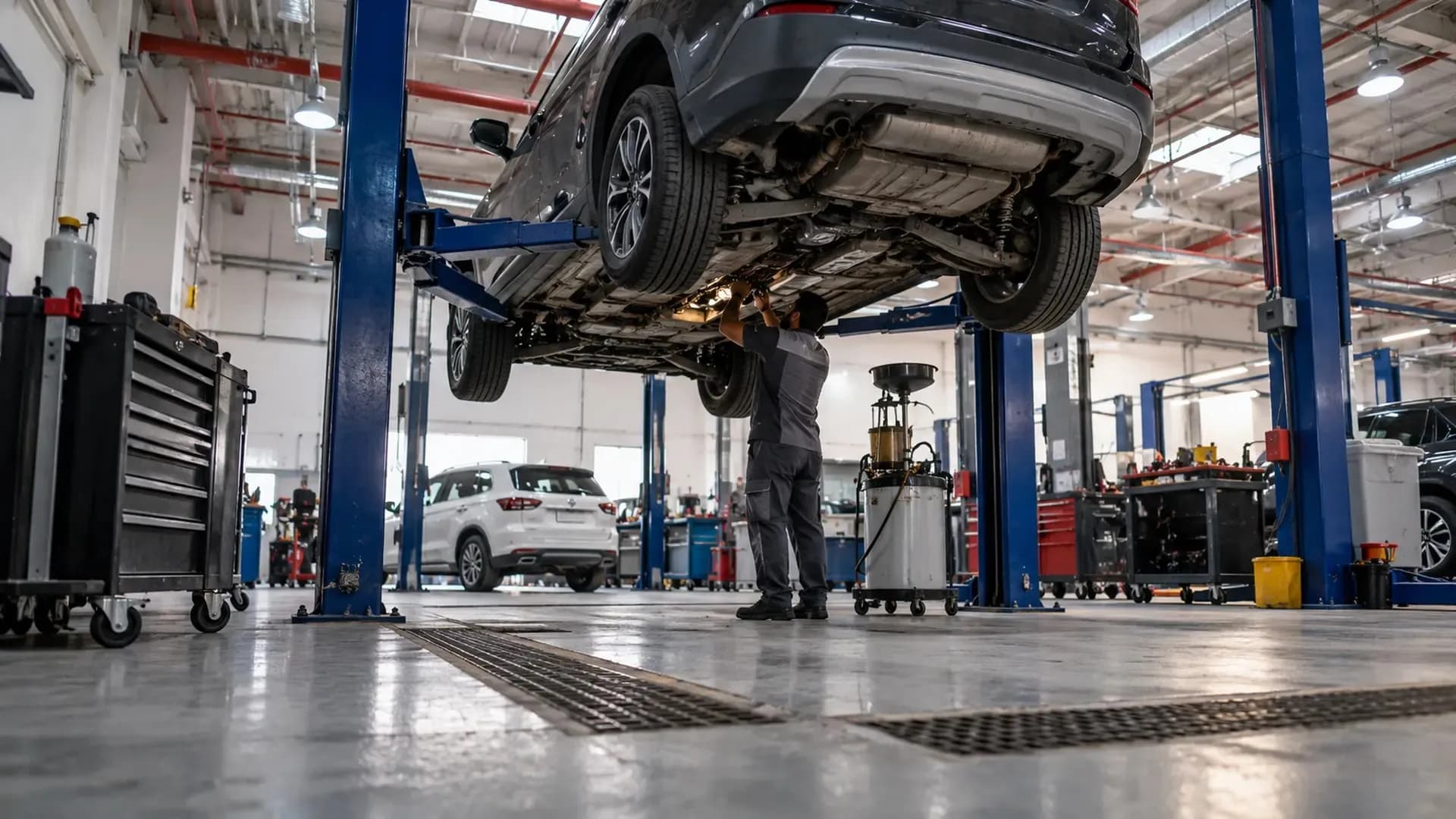
Car repair, detailing and car wash units
Vehicle trades combine almost every risk above. Before you sign:
- List every service. Mechanical, electrical, air conditioning, tyres, bodywork, painting, EV work, washing and detailing can each change the activity, the approvals and the layout.
- Check lifts and pits. Slab capacity, anchoring, headroom, pit condition and water ingress. Ask for lift certificates and confirm they will stay valid.
- Check drainage and oil separation. A car wash needs a working oil separator before any discharge to the sewer. Check where washing water goes, and who services the separator.
- Check painting. If you spray paint, the booth rules on construction, separation and roof exhaust apply.
- Check access and parking. Tow trucks, turning space, waiting vehicles and customer drop-off must fit inside your demise. Many industrial landlords ban parking, storage or work outside the plot. Dubai Investments Park's sublease form, for example, prohibits storage outside the premises and parking or loading outside the plot boundary, and says no modification is allowed without prior approval from Dubai Municipality, Civil Defence and DIP.
- Check contamination. A former garage may have oil in the slab, filled pits or hidden drains. Agree a condition survey and who pays for anything that existed before you.
Laundries, printing, upholstery, tailoring and small production
- Laundries. Washers and dryers need water, drainage, power, heat removal and often steam. Check the approved drainage connection, condensate and lint handling, and noise for neighbours.
- Printing and signage. Large-format printers, cutting and lamination produce heat, fumes and waste inks. Some printing activities also need media approvals; ask the licensing authority whether your activity does.
- Upholstery and furniture repair. Foam, fabric and timber are combustible, wood dust needs extraction, and spray finishing triggers the booth rules.
- Tailoring and garment work. Retail alterations are light; production with steam, washing or printing is not. Describe the process before you choose the unit.
- Candles, soap, ceramics and packing. Waxes, fragrances, kilns and packing materials bring fire load and heat. Products sold to the public may need registration, and teaching classes may need an education permit; ask the licensing authority to classify your full activity.
- Electronics and watch repair. Usually a retail unit with benches, but batteries, soldering fumes and high-value stock need storage, ventilation and security planning.
Light-industrial areas: what changes by address
Workshops in Dubai cluster in areas such as Al Quoz, Ras Al Khor, Dubai Investments Park, Dubai Industrial City and the free zones. The approval route follows the plot, not the area name.
- Mainland areas such as Al Quoz and Ras Al Khor. DET licenses the activity; Dubai Municipality usually handles building permits. Confirm the plot's approved use.
- Dubai Investments Park. DIP's own conditions apply on top of government approvals. Its sublease NOC application costs AED 525.
- Dubai Industrial City. Not a free zone; licensing is through DET and fit-out and building permits through the Dubai Development Authority. The DDA's fit-out permit costs AED 0.90 per square foot (minimum AED 200, maximum AED 10,000) plus AED 20, and structural changes, a change of use or added floor area need a building modification instead.
- Free zones. The zone's licence, lease and operating approvals apply. A free-zone company that wants to operate a mainland unit can use DET's branch licence (AED 10,000 a year) or temporary permit of up to six months (AED 5,000), with its free-zone authority's approval, but the activity must still be allowed at the new address.
Renting or buying a workshop
Renting. Mainland leases fall under Law No. 26 of 2007 as amended; register the contract through Ejari (AED 177.75 online or AED 220 at a trustee centre). The parties can agree to lease a unit before it is finished, with the contract deciding who pays to complete it.
Buying. Verify the title and approved use, read existing leases (a fixed-term lease continues after a sale), and budget for the general 2% + 2% registration fee and 5% VAT on commercial property. Treat environmental history as part of the price.
Clauses to agree before you pay
- Approvals as conditions. Activity confirmation, building and fire approvals, and any environmental approval, with a deadline and a refund if refused.
- Services. Allocated power, water, drainage connection, interceptor and extraction route, listed and tested.
- Maintenance. The landlord carries maintenance unless the contract says otherwise. Name the roof, doors, drainage, interceptors and fire systems.
- Alterations. Tenant works need the landlord's permission and the required licences. Attach your layout and equipment list.
- Subletting and shared bays. Subletting needs the landlord's written consent unless the lease allows it.
- Contamination. A dated baseline, and who pays for what existed before you.
- End of lease. List which lifts, pits, booths, ducts, separators and machines stay or go, and the handover standard. Improvements cannot be removed unless agreed.
From shortlist to opening
- Write the operating brief: services, machines, chemicals, vehicles, customers, hours.
- Confirm the activity and outside approvals with DET or the free zone.
- Check the unit: drainage, extraction route, power, slab, doors, fire file, building age.
- Sign a lease or offer with the conditions above, then register Ejari or the sale.
- Get building, fire and any environmental approvals for your layout.
- Install, test and certify equipment; arrange a licensed waste carrier.
- Pass inspections and open.
Frequently asked questions
Does a car wash in Dubai need an oil separator?
Yes. Dubai's sewerage law requires oil factories and car wash stations to install traps that separate oil from wash water before discharge, and Dubai Municipality can cut the water supply if the trap is not working or oil exceeds the limits.
What are the rules for a paint spray booth in Dubai?
Dubai Municipality's guideline requires non-combustible construction and flooring, at least 3 m from other operations, flames and sparks at least 6 m away unless partitioned, and an exhaust stack at least 1.5 m above the highest roof.
How often must workshop lifting equipment be certified?
Dubai Municipality's lifting guideline requires testing and certification every 12 months by an EIAC-accredited third party, with the safe working load displayed and the certificate kept on site.
Can I put used oil and solvents in normal bins?
No. Hazardous waste must not go into ordinary waste containers, must be stored with a Dubai Municipality permit, and must go only to a licensed carrier.
Is Dubai Industrial City a free zone?
No. Licensing is through DET and fit-out and building permits through the Dubai Development Authority.
Does the 2026 building safety law affect older workshop buildings?
Yes. Owners must obtain a Quality and Safety Certificate once 20 years have passed since the completion certificate, and must maintain younger buildings and fix defects that risk structural safety.
Who issues environmental permits for industrial workshops?
Since 20 August 2026, environmental permits for industrial projects are issued by DECCA after Dubai Municipality transferred the service.
Related guides
- Dubai Industrial City: Warehouses, Land and Operational Due Diligence
- Jebel Ali Industrial Area 1 Dubai: Use, Power, Loading and Licensing Checks
- Commercial Power Load and Utility Capacity Before Buying or Leasing Dubai Premises
- Commercial Fit-Out Reinstatement in Dubai: Handover Duties at Lease End
- Is a commercial property in Dubai suitable for your business? Six checks before you commit
Talk to Laguna Life
Looking for a workshop or light-industrial unit? Send us the location, the size and the work you will do there, and we will tell you what to check before you pay a deposit. Call or WhatsApp Laguna Life on +971 56 100 0928.
Official sources
- Local Order No. 8 of 2002 on sewerage, irrigation and water drainage
- Law No. 18 of 2024 regulating waste management in Dubai
- Law No. 3 of 2026 on the quality and safety of buildings in Dubai
- Dubai Municipality: Examination and certification of lifting equipment (DM-HSD-GU48, V5)
- Dubai Municipality: Paint spray booths (DM-HSD-GU42, V4)
- Law No. 4 of 2025 establishing the Dubai Civil Defence General Command
- Dubai Municipality: environmental permits moved to DECCA (20 Aug 2026)
- Law No. 2 of 2026 on public safety in Dubai (Arabic)
- Dubai Industrial City: FAQs
- DDA: Fit-out permit
- Dubai Investments Park: Sublease NOC form, industrial/warehouse
- Law No. 26 of 2007 regulating the relationship between landlords and tenants
- Law No. 33 of 2008 amending Law No. 26 of 2007
- Executive Council Resolution No. 11 of 2025 on free-zone establishments
- DLD: Register or renew a tenancy contract (Ejari)
- Federal Tax Authority: commercial real estate FAQ
Last reviewed: 6 November 2026. This guide is general information, not legal advice.